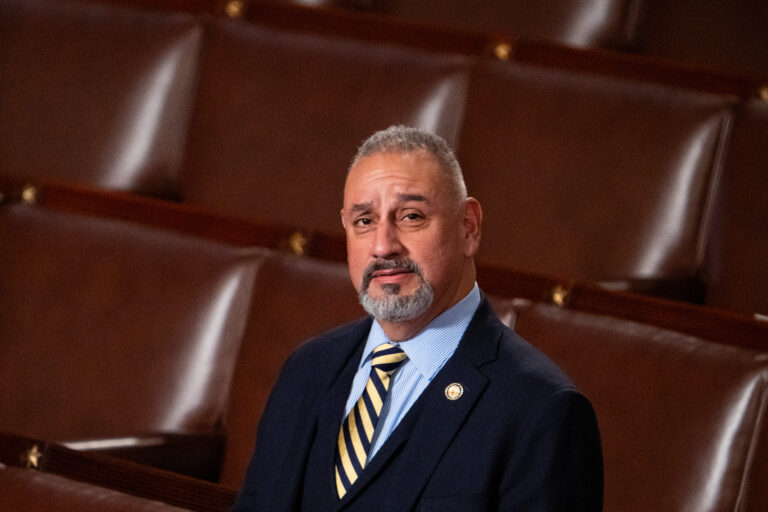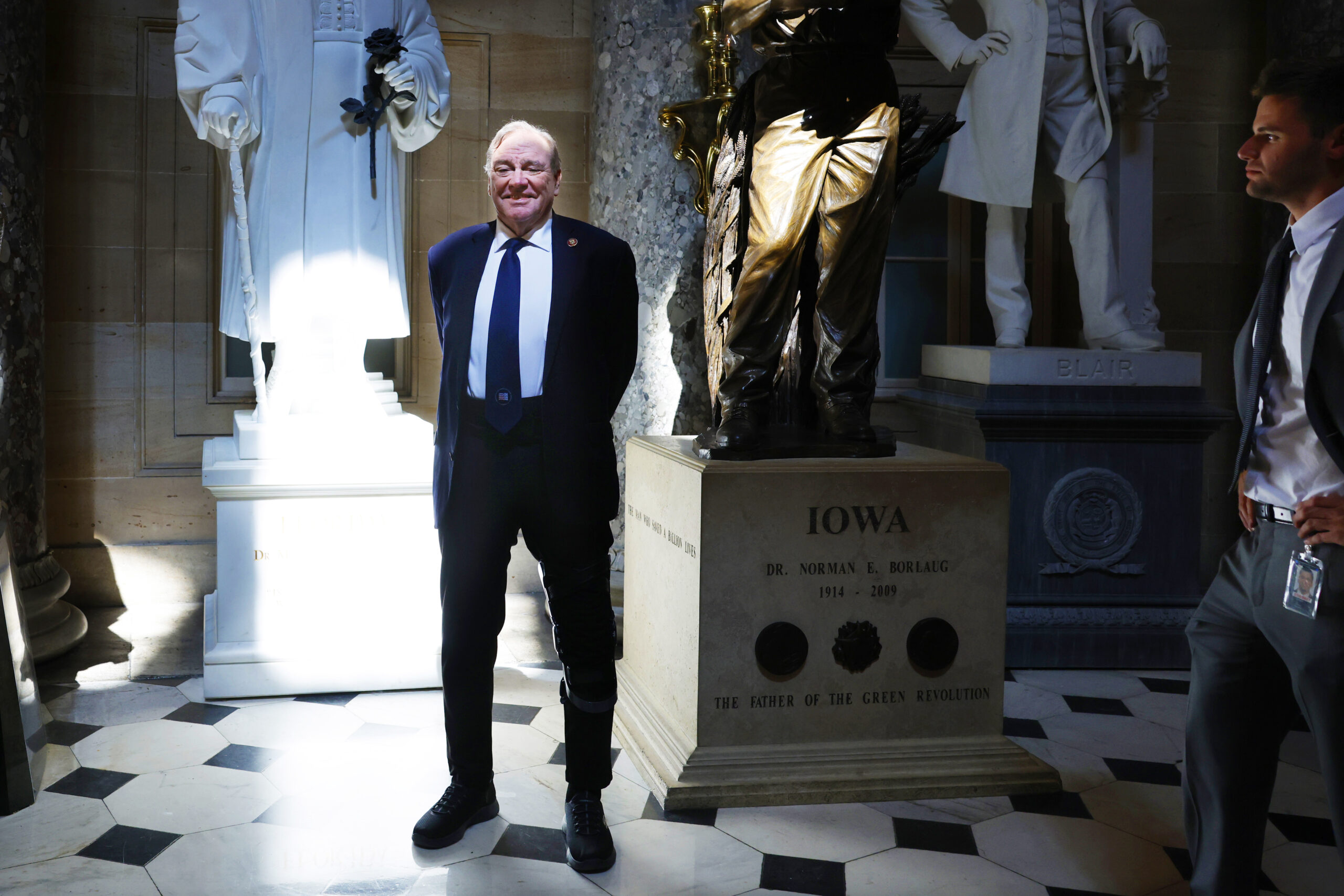
Rep. Neal Dunn (R-Florida) inside Statuary Hall at the US Capitol. Dunn has a terminal heart disease and rather than resign, Dunn is going to finish out his term and will be on hand for any tough votes that leadership needs.
Rep. Neal Dunn shows up for votes these days in a scooter that helps get him to the House floor. A sign is taped to the front of it, allowing him to serve as a one-man mobile lobbying shop:
Read more Democrats Lock Back In on Maine
“Get the REPAIR ACT Dunn!!!”
The Florida Republican, who is retiring at the end of this term, has made the bill — which would defend the rights of independent auto repair shops — his legislative swan song.
Dunn, 73, almost resigned earlier this year after a terminal heart disease diagnosis. But after working with doctors at Walter Reed Medical Center, he has committed to serving out the remainder of his term.
Trending
-
Suspicion and Doubt at the National Civics Contest
-
Mike Johnson Is ‘Sick of This Shit’ (But Sorry He Said So)
-
Democrats Want a DCCC Reset After Three High-Profile Losses
-
Democrats Lock Back In on Maine
“I do what I do because it’s a mission, really, a mission,” Dunn told NOTUS in an interview Tuesday. “You run for office, and it’s kind of like joining the Army. You do a mission, and you can’t leave the mission.”
Dunn’s proposal was slated to be part of the federal highway bill, but support for it fell apart just before the House Energy and Commerce Committee took up the provision amid pushback from powerful auto lobbying forces.
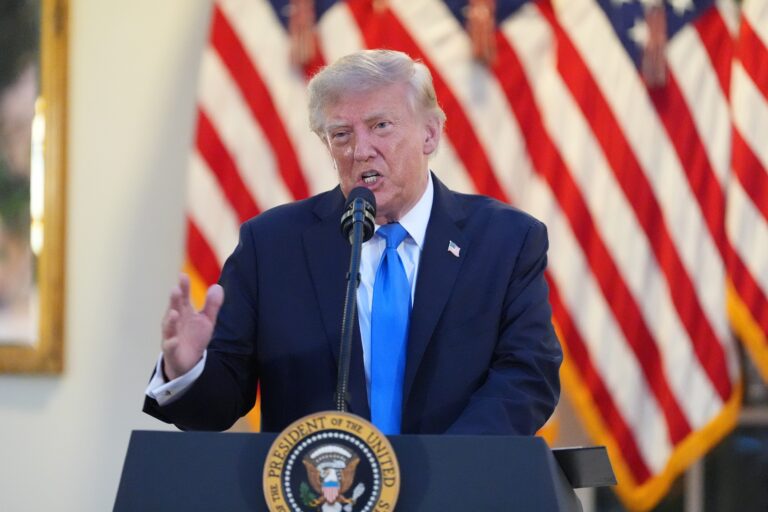
Dunn’s new strategy has now largely focused on trying to win over an audience of one: President Donald Trump.
He talks more frequently with the president than most rank-and-file lawmakers, in part because of Trump’s role in giving Dunn a little more of a lease on life.
In the late winter, as his diagnosis grew bleak, Dunn drew up a plan with Florida Gov. Ron DeSantis to “sneak out the back door” into retirement. He would announce his resignation set to some point in July, and the Republican governor could call a special election for then.
Dunn intended to serve right up until that time, if his health allowed, so that his replacement in the heavily Republican district could be selected and House Speaker Mike Johnson would not lose a reliable GOP vote for any length of time.
Then Trump called Dunn from the golf course with DeSantis and told him not to retire.
“I’ve got the best doctors in the world. They’re big. They’re beautiful. They’re on their way. Don’t go anywhere,” Trump said, as Dunn recalled.
That stint at Walter Reed bought Dunn more time, but it didn’t heal him.
“No question, my prognosis is better than it was,” he said. “You know, I’m still on a glide path.”
At a March news conference, Trump blurted out that Dunn would have been “dead by June” if not for his intervention, something the lawmaker was trying to keep private.
“Obviously Trump kind of outed me there,” he told NOTUS, smiling.
Ever since, he’s pledged to be on hand for Johnson and Trump anytime an important, close vote is scheduled. He flew up from Florida for crucial votes on Tuesday and Wednesday on national defense policy, but he did not attend Thursday’s less consequential votes on other matters.
Rank-and-file Republicans applaud Dunn’s perseverance as other perfectly healthy members skip key votes to campaign for higher office.
In a different congressional era, lawmakers facing their own mortality were granted a last favor. Just before he died in 2001, Rep. Joe Moakley (D-Massachusetts), who had chaired the House Rules Committee for years, asked Democratic leaders for a final wish: install his former aide, Rep. Jim McGovern, to the rules panel.
McGovern got the nod and now serves as the committee’s top Democrat.
So far, Dunn has received no such reward for his loyalty, but the president did voice support for independent repair shops at an Oval Office event last month, a day after he met with top car manufacturer CEOs.
“They don’t want people to fix their car. I said, ‘That’s strange, I’d never heard of that.’ They have a thing — nobody’s allowed to fix their car,” Trump told reporters.
Read more McConnell’s Absence is Grinding Some Senate Business to a Halt
“We’ll get it all straightened away,” he added.
Dunn, an Army-trained surgeon, served his residency at Walter Reed and eventually ran a large urology practice in Florida. Given his background, his passion for the Right to Equitable and Professional Auto Industry Repair Act is perhaps a surprising coda to his congressional career. But Dunn fought (and won) a similar battle with medical devices, and dove in when he found out the same debate was happening in the auto industry.
But Dunn is up against a very powerful duo of lobbying forces: large auto manufacturers and car dealers.
“The basic moral question is: If I buy a car, truck, a motorcycle, whatever, from you, is it mine or is it yours? It’s mine,” he said. “I buy it, and you know who owns it, and then I should be able to control it. If I want to put a torch to the thing, I can do that — but I can’t repair it? That’s crazy.”
Dunn says the bigger corporations are trying to force car owners into pricier repairs, freezing out the usually cheaper independent operators. This comes as new cars have soared in cost and Americans are holding on to their old cars longer than ever, making the auto repair market more lucrative than ever.
“Ford, GM, Toyota — they all dug in, and they made it really, really, really difficult to allow the secondary market to continue,” he said.
The lead opponent to the REPAIR Act is the National Automobile Dealers Association, which has accused the car insurance industry of trying to gain access to sensitive “vehicle data.”
“Insurers are pursuing controversial provisions to lower their costs and limit consumer choice by expanding the use of cheaper, non-original and recycled parts for vehicle repairs,” Kerry Feehery, a senior lobbyist for NADA, wrote in a memo last month after the a compromise deal on the bill collapsed.
The Dunn-related compromise would have greatly expanded the amount of auto technology shared with independent repair shops beyond the deal they reached in 2014. Cars have advanced so much technologically over the past decade that repair shops need more information from auto makers and dealers to fix cars.
Rep. Brett Guthrie (R-Kentucky), chair of the Energy and Commerce Committee, acknowledged Thursday that the deal fell apart because the car dealers are very powerful and turned members against the proposal.
“They’re in everybody’s district. I mean, that’s people listening to their constituents, and so that’s what you hear,” he told NOTUS, pledging to try to find more support for Dunn’s original ideas. “We’re still working.”
Dunn came in with the class of 2016, along with a low-profile Louisiana Republican who would go on to become House speaker. But his friendship with Johnson has thus far been unable to overcome the more powerful lobbying forces.
“The speaker has a lot of pressures from different directions, and I don’t know all those pressures. I’m sure that GM and Ford are two of them,” he said.
So far in 2026, GM has spent more on federal lobbying ($11.4 million) than any individual company in America. Only a few major associations like the Chamber of Commerce have a bigger budget.
Time is running short both for the House — it’s scheduled for just 16 days in session over the next three-and-a-half months — and for Dunn’s tenure on Capitol Hill.
Private polling shows overwhelming support for the independent repair shops. So Dunn said he’s hopeful Trump could throw his full support behind the REPAIR Act and get it attached to one of several must-pass bills at the end of the year.
“There’s just not that many issues that are 85 percent. So, you know, I feel good about it,” he said.
Read more It’s 9 A.M. Somewhere
Dunn paused to consider the forces he is up against.
“I’m not — I’m not betting my soul on it.”
About the Author