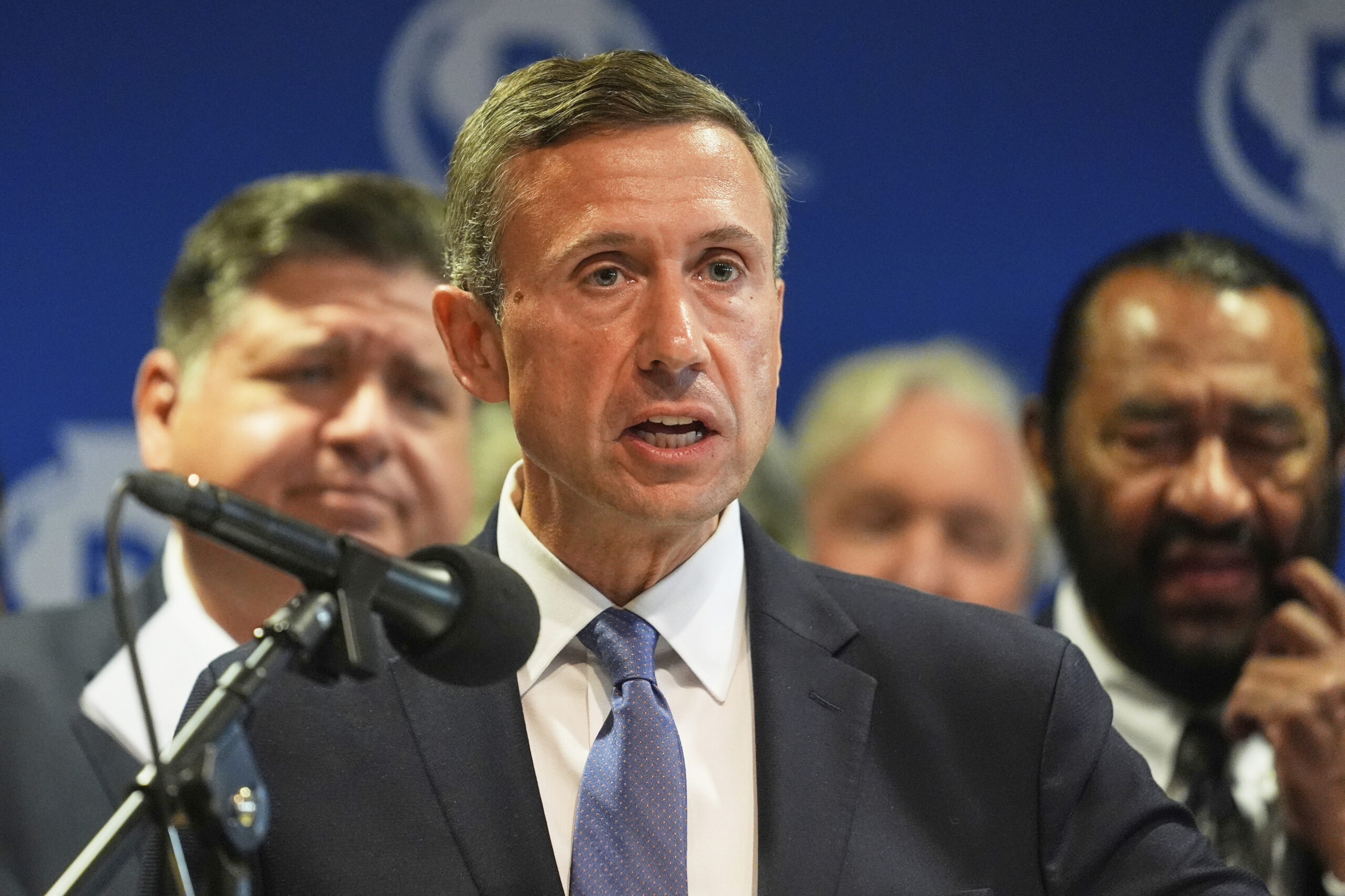
FILE - DNC Chairman Ken Martin speaks during a news conference in Aurora, Ill., Aug 5, 2025. (AP Photo/Erin Hooley, File)
South Carolina, Nevada, New Hampshire, New Mexico, Michigan and Virginia — that’s the 2028 Democratic presidential primary lineup.
Read more The LeBron James Sixers Really Could Win It All
Members of the Democratic National Committee’s Rules and Bylaws panel voted Friday on its presidential nominating calendar, adding two additional states and preserving South Carolina’s first-in-the-nation status. The slate will now go to the DNC’s August meeting for ratification.
The decision comes after days of last-minute negotiations and lobbying, as members privately debated the slate into the wee hours of Friday morning before their public meeting. The early-state selections will shape how presidential campaigns define their own strategies in 2028, ahead of a wide-open and likely crowded primary contest.
“Now, instead of reacting to whomever’s left, we now get to shape what the field actually looks like, and I think that’s important,” said Jaime Harrison, a former DNC chair and South Carolina Democratic Party chair. “It’s a different role for us.”
Trending
-

Mike Johnson Is ‘Sick of This Shit’ (But Sorry He Said So)
-
National Guard Signs $292M Housing Contract for Troops in Washington, D.C.
-
Suspicion and Doubt at the National Civics Contest
-
The Woman in the Photo Wanted to Be Alone. Instead, She Went Viral.
South Carolina narrowly edged out Nevada for the first-place slot, after several impassioned speeches by boosters from both states. New Hampshire, which lost its first-in-the-nation primary status in 2022, was a distant third.
It’s not clear how New Hampshire will respond to the new calendar, given that its state law requires it to host the first-in-the-nation primary. In a statement after the vote, the New Hampshire Democratic Party reiterated that the DNC’s decision “does not change the realities governing New Hampshire’s primary, which are beyond the control of both this committee and our state party.”
Several DNC members suggested New Hampshire could hold a party-run primary process, separate from its state-run primary. But it’s not clear whether New Hampshire Democrats would agree to that suggestion.
“Among other issues, it would cost millions of dollars,” said one New Hampshire Democratic operative. “Is the DNC with all of their cash reserves going to pay for that?”
The state’s delegation released a blistering statement, which said the DNC’s decision “is wrong for Democrats, wrong for New Hampshire, and wrong for the country.”
When pressed by reporters on how the DNC would respond to New Hampshire, should state Democrats opt to ignore the DNC’s schedule, DNC Chair Ken Martin said they’d “have to cross that bridge when we get there,” adding that “we don’t want to presume anything at this point” about how the state might respond.
By adding New Mexico and Virginia, the DNC is opening its early window even wider, further diversifying the regions and racial makeups of the states at the front of the contest. Nearly two decades ago, ahead of the 2008 presidential primary, the committee added Nevada and South Carolina to the opening lineup in efforts to highlight the voices of more voters of color.
Read more The Pentagon Faces Questions After Casualties Disappeared From Public Tracker
Martin strongly supported the expansion, urging members on Thursday to add a fifth state that “needs to be from the South.”
It was only four years ago that Democrats upended their process ahead of the 2024 election. Then-President Joe Biden elevated South Carolina and pushed to eliminate Iowa, after its disastrous 2020 caucuses. New Hampshire ran an unsanctioned primary in 2024, though the DNC stiffened its penalties on states and candidates that would participate in rogue contests in 2028.
Now, South Carolina will lead off the 2028 primary on Jan. 22, followed by Nevada on Feb. 1. The DNC scheduled New Hampshire for Feb. 8, though it’s not clear if it will follow that guidance. New Mexico would hold its primary on Feb. 15, followed by Michigan on Feb. 22 and Virginia on Feb. 29. Super Tuesday is March 7.
South Carolina’s hold on the influential, first-place perch, as well as additional Southern representation, gained greater salience after the Supreme Court further gutted the Voting Rights Act earlier this year, several members said.
Christale Spain, South Carolina’s Democratic Party chair, said her state provides “the most reliable read” on Black voter “sentiment.”
“The South is not the past, it is the future,” she added.
There was some disagreement among members over scheduling New Mexico ahead of Michigan, skipping the midwestern region. But given the speed at which states needed to move their dates, it’s unlikely Michigan could have changed its date, given a Republican-controlled state House.
“Over the period of six weeks, every one of those states is going to get a lot of attention, and so, I don’t think it matters where Michigan fell in that calendar, although I understand the concern,” Martin said. “When you think of all the other states and the number of delegates that will come out of Michigan and Virginia, compared to the other states, there’s no way they’re going to be overlooked by the process.”
Michigan Rep. Debbie Dingell said she’d back the calendar because she wanted to leave the meeting “united.”
“What we are doing this time is building, as we vote for six states, building the story of the Democratic tent,” Dingell said. “No one state should ever have a lock on going first.”
Read more Bowser’s Final Lap
About the Author