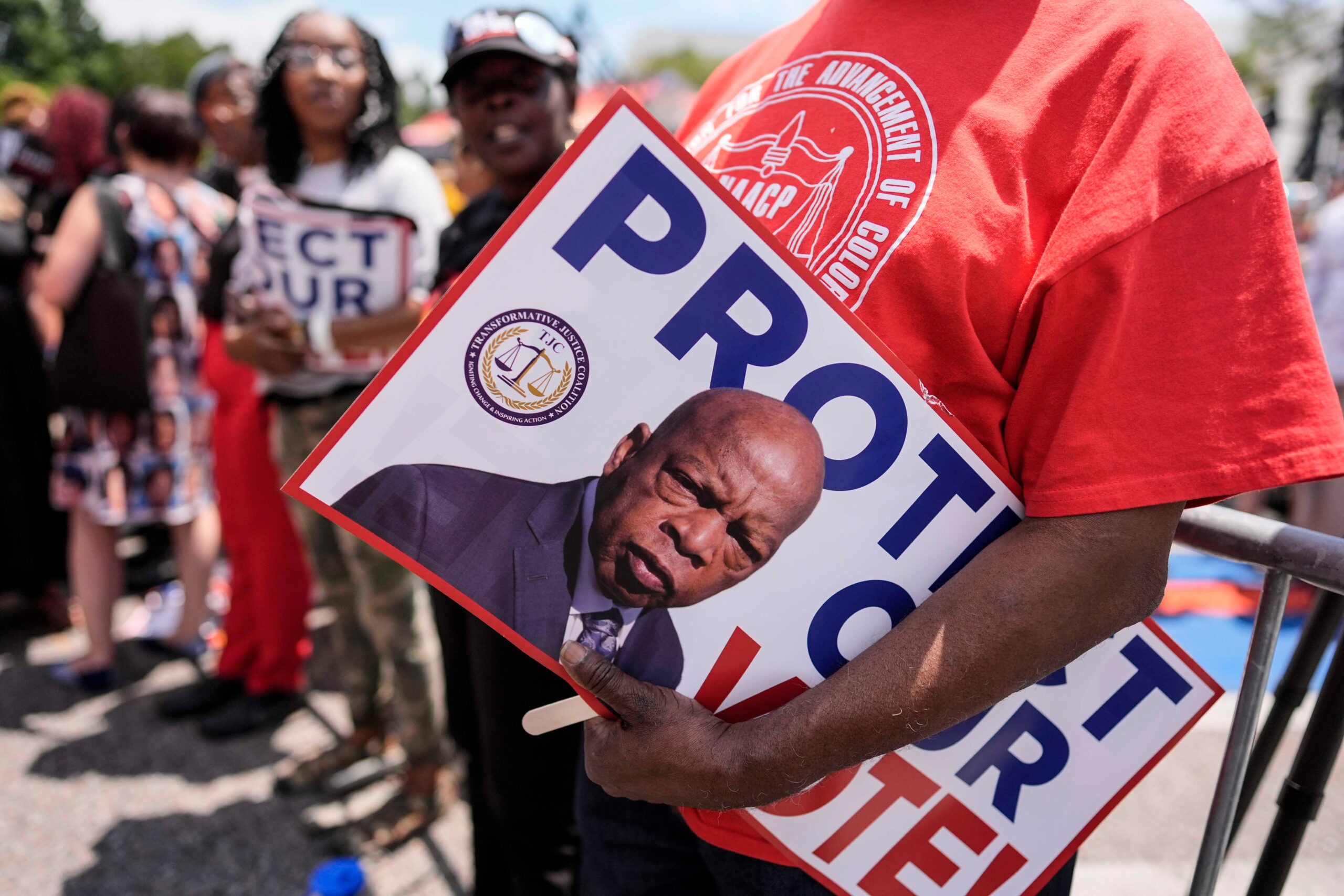
A protestor holds a sign of the late Georgia Congressman John Lewis during a voting rally, Saturday, May 16, 2026, in Montgomery, Ala. (AP Photo/Mike Stewart)
A federal court temporarily Alabama on Tuesday from switching to a new congressional map that Republicans had sought to draw out a majority-Black district held by Democratic Rep. Shomari Figures.
Read more Can a Candidate to the Left of Jared Golden Win in Maine’s 2nd District?
Following the Supreme Court’s April ruling on Louisiana v. Callais, which effectively eliminated Section 2 of the Voting Rights Act, states across the South moved to redraw their congressional lines in favor of Republicans. In Alabama, Gov. Kay Ivey scheduled four House primaries for August after the Supreme Court separately sent the case to the lower court, opening a path for the state to use 2023 congressional maps that a federal court had previously struck down for being racially discriminatory toward Black Alabamians.
A three-judge panel issued Tuesday’s preliminary injunction, requiring the state to continue using the same court-ordered districts under which congressional representatives were elected in 2024. The decision was made by Judge Stanley Marcus, appointed by Bill Clinton, and Judges Terry Moorer and Anna Manasco, who were each appointed by Donald Trump. The ruling was a defeat for state Republicans who want to use a map for the November midterms that would redraw Figures’ seat to be more friendly to Republicans.
Figures’ district is one of two majority-Black districts in the state. In its lengthy opinion, the panel agreed with the plaintiffs that they could not “understand the 2023 plan as anything other than intentionally discriminatory.”
“We reject in strongest possible terms the State’s attempt to finish its intentional decision to dilute minority votes with a veneer of legislative regularity,” the panel wrote.
The court-ordered map Alabama used in the last federal election required a second district where Black voters make up the majority or close to it — a mandate that resulted in the states’ second majority-Black district and Figures’ 2024 election as the state’s second Black House member.
Read more Progressive Group Boosts Abdul El-Sayed in Contentious Michigan Senate Race
In a statement on Tuesday following the ruling, Figures said that the “case is still not over.”
“Althought we expected the Court to reach this decision given the overwhelming evidence, we fully expect the State to immediately appeal the decision to the Supreme Court,” Figures wrote. “This is a significant step in the right direction, but there is still a long way to go before this fight is settled.”
Representatives for the governor’s office did not immediately respond to requests for comment, including a question about whether the state would appeal Tuesday’s decision.
Tuesday’s ruling at least temporarily reverses the momentum that state Republicans had briefly gained after the Supreme Court’s ruling last month. Following the Callais decision, Tennessee quickly redrew its congressional map so that all seats favored Republicans, and the South Carolina, Louisiana and Mississippi legislatures are considering redrawing their maps.
Read more Democrats Have an Age Problem. Some Republicans Admit They Do, Too.
About the Author