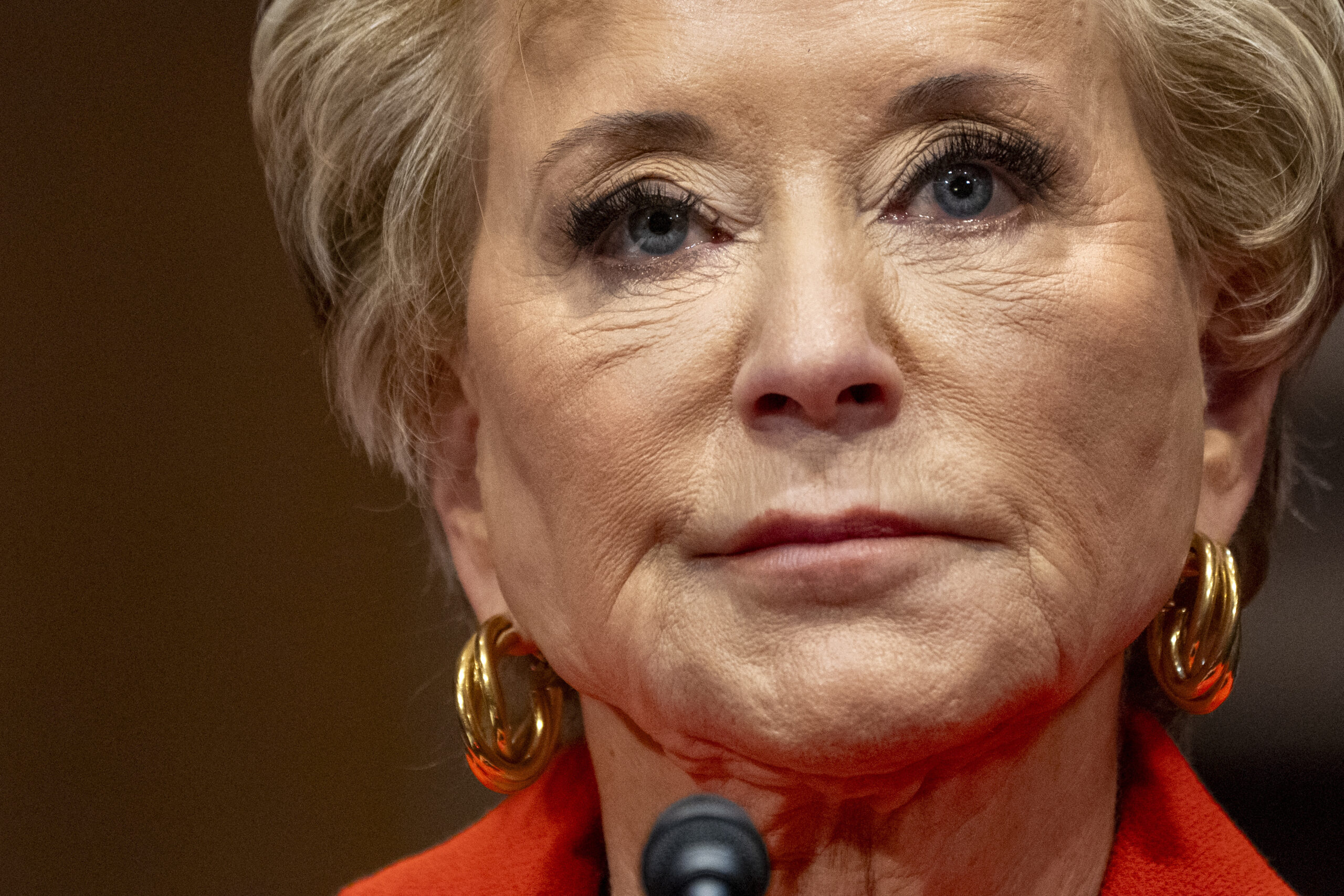
Linda McMahon, President Donald Trump's nominee for Secretary of Education, attends a hearing of the Health, Education, and Labor Committee on her nomination, Thursday, Feb. 13, 2025, in Washington. (AP Photo/Jacquelyn Martin)
A federal judge temporarily suspended a key provision of an Education Department on Thursday, potentially opening the door for students pursuing nursing and other medical graduate degrees to qualify for more federal student loans, less than a week before the Trump administration’s sweeping borrowing limits were due to take effect July 1.
Read more Supreme Court Clears the Way for Trump to Dismantle TPS
U.S. District Judge Beryl Howell ruled that the plaintiffs were likely to succeed on their claims that the government’s definition of “‘professional degree’ is contrary to law” and supported their assertion that “they would suffer irreparable harm should the Rule go into effect.”
The American Association of Nurse Practitioners and the Physician Assistant Education Association filed lawsuits against Education Secretary Linda McMahon and the department, respectively. Howell ruled for both cases, acknowledging the plaintiffs’ “understandable angst” over the new federal student loan caps.
The Education Department and the plaintiffs did not immediately respond to requests for comment.
The Education Department’s rule capped graduate student loans at $20,500 annually, with an aggregate cap of $100,000. The rule designated 11 graduate degrees as “professional” programs, offering students studying dentistry, law and medicine, among other fields, a higher annual loan cap of $50,000 and an aggregate cap of $200,000.
The new regulation ended the Grad PLUS loan program — created by Congress in 2005 to allow students to borrow up to their school’s full cost of tuition.
The medical groups primarily took issue with the Trump administration’s decision to omit students in advanced nursing and physician assistant programs from the “professional” category, making them ineligible for the higher loan cap.
Read more Military Changes Voluntary Flu Vaccine Guidance After Boot Camp Outbreak
The Education Department implemented the new rule as part of the Working Families Tax Cuts Act, which contained the provisions of the One Big Beautiful Bill that Trump signed into law last year. The legislation included sweeping changes to tax policy and cuts to social programs like Medicaid, Medicare, federal food assistance and federal student loan borrowing.
The regulation received significant bipartisan pushback when it was announced, with Sen. Jeff Merkley (D-Oregon), Sen. Roger Wicker (R-Mississippi), Rep. Jen Kiggans (R-Virginia) and Rep. Suzanne Bonamici (D-Oregon) leading a group of 140 lawmakers in opposition to part of the Education Department’s rule that did not include nurses in the “professional” group with higher loan caps.
“The proposed definition threatens more debt for post-baccalaureate nursing students,” the lawmakers said in a December news release.
The coalition of lawmakers also raised concerns about the broader impacts of the rule on the medical workforce.
“At a time when our nation is facing a health care shortage, especially in primary care,” the lawmakers wrote, “now is not the time to cut off the student pipeline to these programs.”
Read more Top General’s Early Exit Shows Hegseth’s ‘Paranoia,’ Tillis says
About the Author