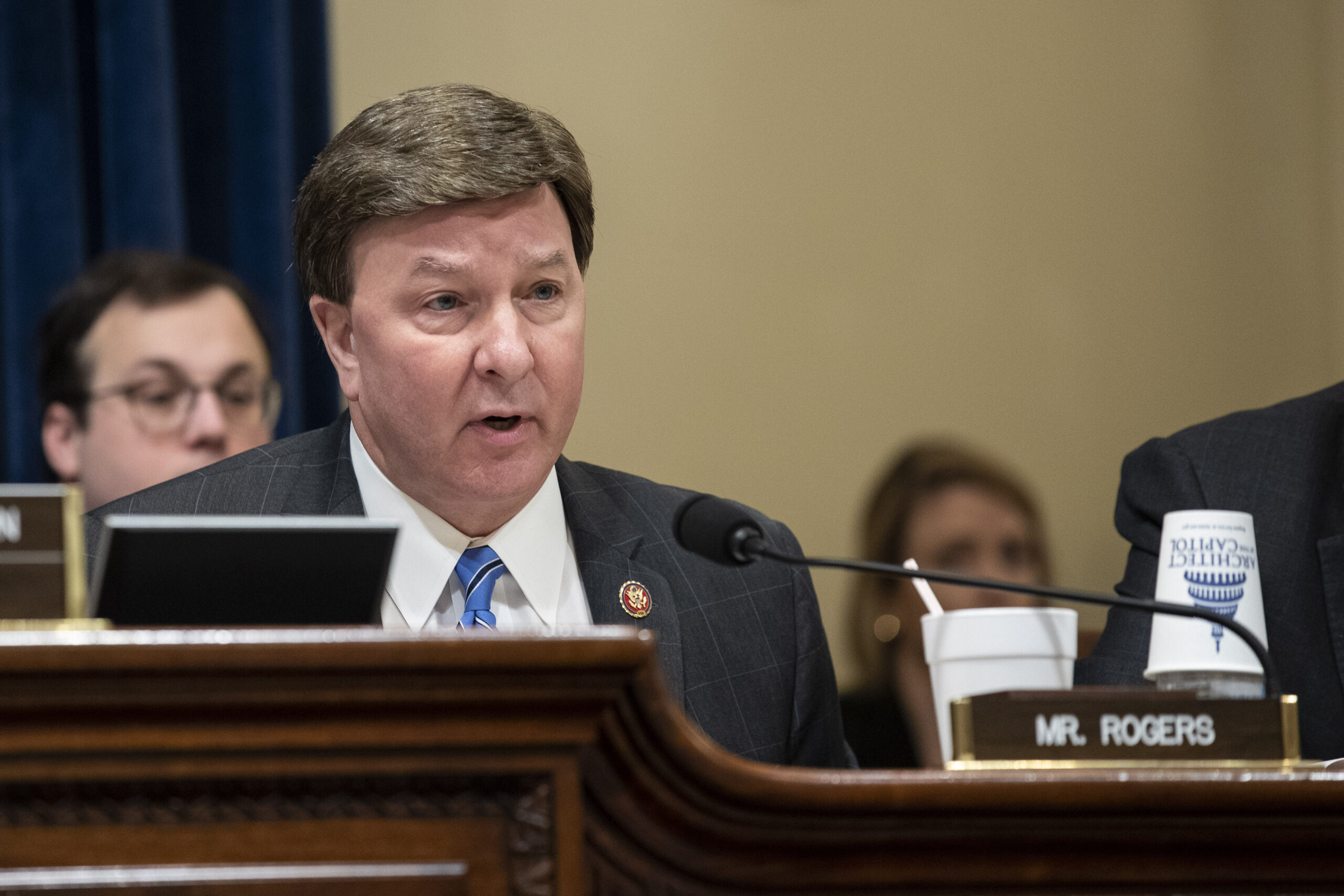
House Committee on Homeland Security ranking member Rep. Mike Rogers, R-Ala., speaks as Acting Secretary of Homeland Security Chad Wolf testifies before a House Committee on Homeland Security hearing on the coronavirus and the FY2021 budget, Tuesday, March 3, 2020 in Washington. (AP Photo/Alex Brandon)
The House narrowly approved sweeping defense policy legislation that codifies President Donald Trump’s Pentagon plans, including his “Department of War” rebrand and push to deny coverage for health care to transgender troops.
Read more Senate Farm Bill Negotiations Are Stuck During McConnell’s Absence
Just six Democrats voted for the $1.15 trillion National Defense Authorization Act, while all but seven Republicans backed the bill. The final vote was 216-212.
The NDAA’s passage was a win for House Speaker Mike Johnson, who agreed this month to merge the SAVE America Act with the defense policy bill in order to quell a rebellion from his hard-right members, led by Florida Rep. Anna Paulina Luna. The SAVE America Act, a top priority for Trump, would require proof of citizenship to register to vote in federal elections and showing an ID to cast a ballot.
Democrats largely rejected the NDAA as a referendum on the Iran war and Trump’s budget request, which seeks $1.5 trillion for defense while slashing social programs.
Trending
-

Suspicion and Doubt at the National Civics Contest
-

Dana Milbank: Maybe Pete Hegseth Is the One With a Testosterone Problem
-

EPA Must Fund Environmental Grants It Illegally Canceled, Judge Rules
-
Senate Farm Bill Negotiations Are Stuck During McConnell’s Absence
“Whatever else may be said about the NDAA — there’s a lot of positive aspects to it — it will continue to support the Department of Defense that the president is using to wage this war, this incredibly disastrous, terrible decision of a war,” said Rep. Adam Smith of Washington, the top Democrat on the House Armed Services Committee.
The panel’s top Republican, Rep. Mike Rogers of Alabama, has argued the bill is necessary to support troops, foster innovation and strengthen an eroding defense industrial base in the face of China’s growing might.
“We are giving industry the certainty it needs to invest, expand and produce faster,” he said.
House Republicans on Tuesday crossed a red line for many Democrats when they added a provision to ban gender-affirming care for service members and their dependents through Tricare, the military’s health care plan. They also included an amendment barring transgender girls from participating in girls’ sports at Defense Department schools for military families.
Other hard-right amendments included language to approve the default when qualified service members and Pentagon civilian employees ask commanders for permission to carry personal firearms on military installations.
Read more Judge Sets Maduro Criminal Trial for June 2027
Lawmakers also added some measures opposing divisive Pentagon policies, including one that would restore collective bargaining at the Defense Department. Others include a mandate to restore military base names selected by Congress’ bipartisan renaming commission, new reporting requirements when senior military officers are fired and restrictions on the construction of the Navy’s proposed “Trump-class” battleship.
The bill is not in its final form. Democrats and Republicans typically reconcile separate versions from the House and Senate with final passage expected in December. The NDAA is considered must-pass legislation, and Congress has drafted and passed a version each year for decades.
The most controversial provisions in the House-passed bill have little chance of clearing the Senate, where bipartisan support is needed to advance legislation. The views of the president, who holds veto power, will also be a factor in composing any final bill.
Senate Democrats will “robustly” oppose any GOP anti-trans provisions, said Sen. Jack Reed (D-Rhode Island), the Senate Armed Services Committee’s ranking member. “I mean, getting into the medical diagnoses and all those things, it’s an issue that is more to appease their supporters, not to help personnel or to make the military better.”
Last week, Senate Democrats blocked Republicans from bringing their chamber’s version of the bill to the floor to protest the Trump administration’s Iran war and attempt to gain leverage in negotiations over next year’s federal budget.
House and Senate negotiators have in the past reconciled a House-passed and Senate Armed Services Committee-passed bill. This week, Sen. Roger Wicker (R-Mississippi), the panel chair, did not rule out that strategy.
“That’s not an ideal process, but we’ll get it done at some point, the sooner the better,” Wicker said. “But it speaks volumes that our Democratic colleagues were not even willing to proceed to the bill.”
Read more The Trump Administration Moves to Stop Collecting Workplace Demographic Data
About the Author