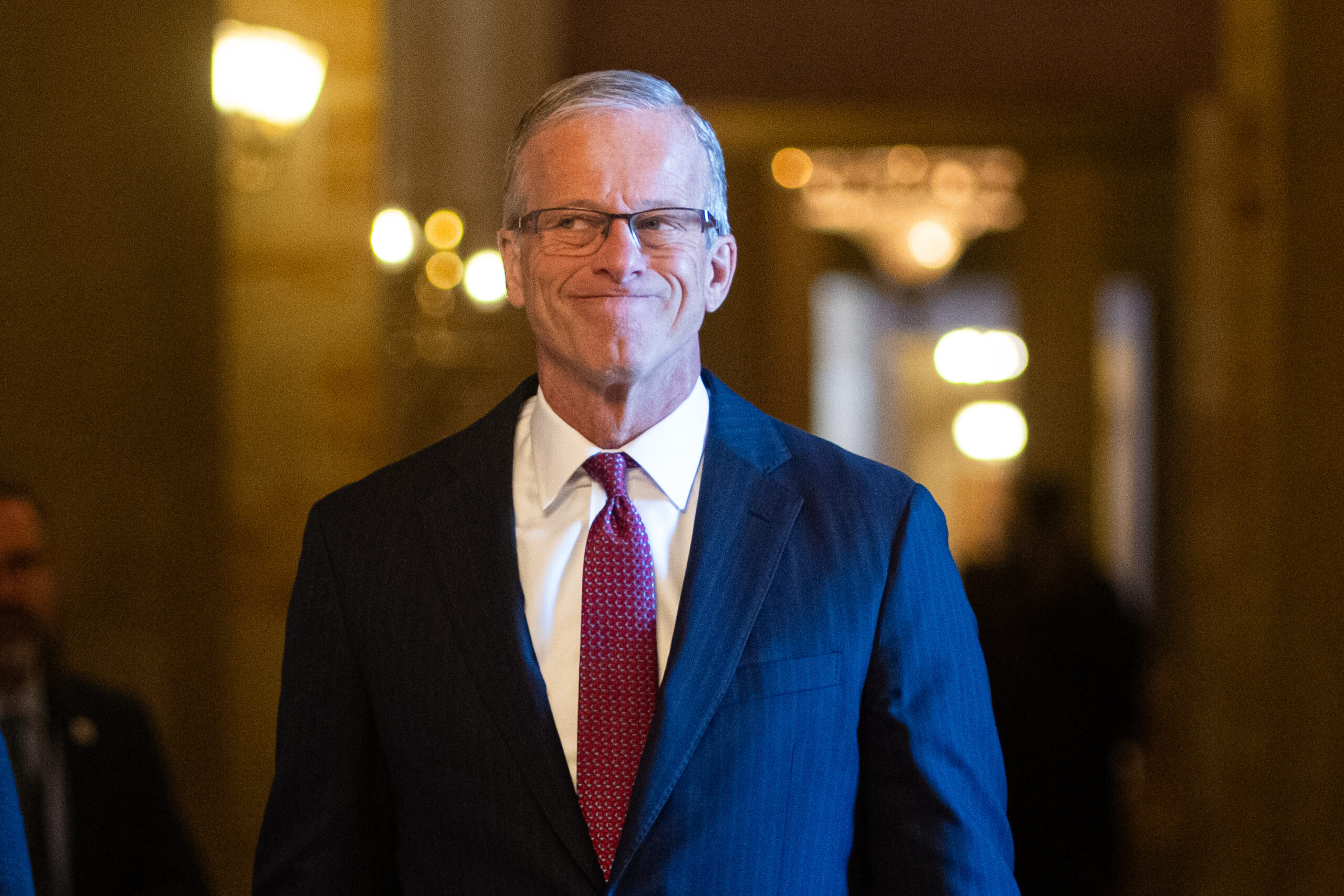
UNITED STATES - JANUARY 28: Senate Majority Leader John Thune, R-S. Dak., walks to the Senate floor on Wednesday, January 28, 2026. (Bill Clark/CQ Roll Call via AP Images)
Senate Republicans are moving ahead with a multibillion-dollar spending bill for immigration and border enforcement after the White House dropped plans for a controversial ‘anti-weaponization’ fund.
Read more Republican Rep. Daniel Webster Violated the STOCK Act. Again.
The Senate advanced the budget reconciliation legislation Wednesday, 53-46, in a party line vote. The chamber could consider dozens of amendments to the package on Thursday during a “vote-a-rama” with hopes of sending the legislation to the House by the end of this week.
Senate Republicans had previously blocked the legislation over concerns about President Donald Trump’s $1.8 billion “anti-weaponization” fund, which was announced as part of his settlement with the IRS over leaked tax forms. Some senators who warned the fund could have been used to boost Trump allies wanted to impose guardrails on it as part of the bill.
But after acting Attorney General Todd Blanche told lawmakers yesterday that the Department of Justice would not be moving forward with the fund, Senate leadership was able to secure the 50 votes required to advance the measure.
“I think most of our members are pretty satisfied,” Senate Majority Leader John Thune told reporters on Wednesday. “For the most part, his comments were extremely helpful.”
The bill will provide $70 billion to fund the agencies that were not included in a bipartisan deal to reopen most of the Department of Homeland Security following a record-breaking shutdown of the department earlier this year. The measure also dropped $1 billion for White House security, including Trump’s controversial ballroom, a proposal that had also sparked bipartisan criticism.
Sen. Susan Collins (R-Maine), who said previously she was opposed to the “anti-weaponization” fund, told reporters on Wednesday that Blanche’s comments were helpful.
“I will vote to proceed, because there is no funding for the anti-weaponization fund nor for the ballroom,” Collins said.
But she suggested she would support amendments to restrict or shutter the fund during the voting marathon.
Senate Democrats still are expected to introduce a series of amendments that would bar the fund, and Sen. Thom Tillis (R-North Carolina) also said he plans to propose an amendment to formally halt the fund. Tillis said he would vote against the final bill if it does not include language to restrict the fund.
Read more New York Reverses a $21,000 Fine Against the Trump Campaign
Senate Democrats also plan to offer amendments to block a proposal that would bar IRS audits of Trump and his family.
But even with bipartisan support, it’s unclear if any of these amendments are likely to pass. Thune said Wednesday that amendments pertaining to the “anti-weaponization” fund will “most likely” require 60 votes to advance; others also could require the higher threshold.
“We’ve got a sufficient number of Republicans who have been very clear they’ve got concerns here,” Tillis said. “I don’t want to join with some Democratic initiative. I want this to be led by Republicans for Republicans, and we’ll go from there.”
Sen. John Curtis (R-Utah), who voted to proceed with the bill, also said he still has lingering questions about the fund and would be open to supporting amendments that would kill or restrict its uses.
“I need to see what the options are. I need to see what the parliamentarian will allow,” Curtis said. “But I think to the extent that can happen, that would be a good thing.”
Sen. Bill Cassidy (R-Louisiana) indicated that he too wanted to see more included on the fund, saying, “you want to make sure it’s really dead, and I think we can make it really dead.”
Sen. John Kennedy (R-Louisiana) pointed out to reporters ahead of the vote that after weeks of discussion about what should be included in the spending bill, Republicans ultimately ended up at square one.
“In terms of the bill itself, we are right back where we started,” Kennedy said. “That’s why we started this, to fund DHS.”
Read more U.S. Proposes New Tariffs on Countries That Use Forced Labor
About the Author