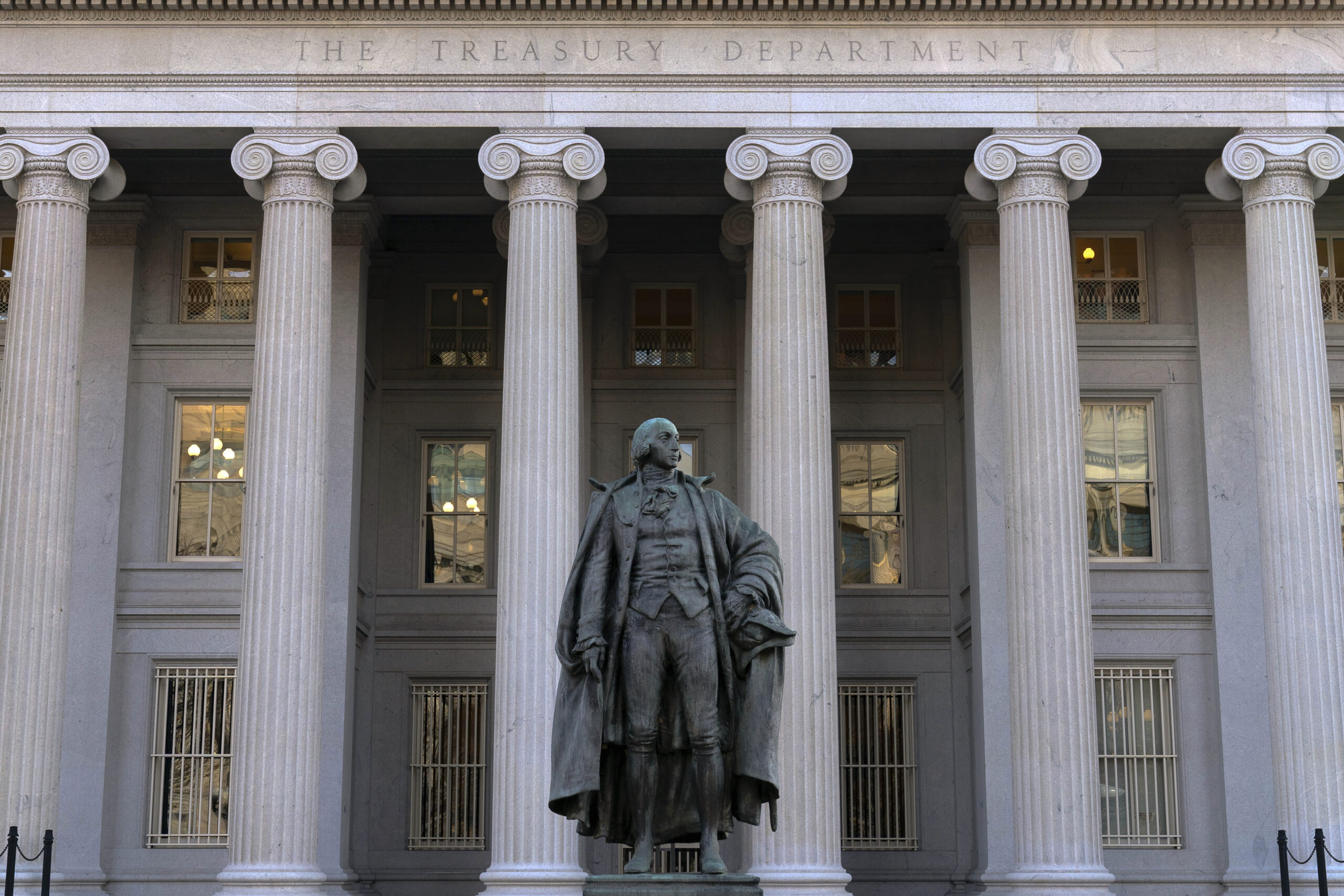
The U.S. Department of the Treasury building is seen in Washington, Monday, Nov. 18, 2024. (AP Photo/Jose Luis Magana)
A billionaire acknowledged on Tuesday that his widely read opinion column in The Wall Street Journal criticizing Treasury Secretary Scott Bessent’s bond market intervention was written using artificial intelligence.
Read more J.D. Vance Is Rattling the GOP’s Old Guard
Stanley Druckenmiller, a former hedge fund manager who founded Duquesne Capital, published “Let the Bond Market Speak” on Monday, questioning Bessent’s interventions to hold down yields on U.S. treasuries. The article drew added attention because Druckenmiller worked with Bessent under George Soros, and is sometimes described as a “mentor” to the treasury secretary.
Pangram, an AI detection tool, found that Druckenmiller’s op-ed had been written using artificial intelligence, according to multiple social media posts. In an interview with NOTUS, Druckenmiller said “of course I used AI” when writing the column, and argued he didn’t see a problem with doing so.
“There’s a reason I moved from an English major to being an economics major,” Druckenmiller said. “I’m not embarrassed by it … I write everything using AI now for the same reason I use a calculator when I do math problems.”
Trending
-

Dana Milbank: Allow Me to Present the Secret War Plans for Trump’s Military Attack on the Bond Market
-
‘They Want Us All To Leave’: Interior Reassigns Dozens of Senior Staff
-

J.D. Vance Is Rattling the GOP’s Old Guard
-

Florida Prepares to Roll Back School Vaccine Requirements
A spokesperson for The Wall Street Journal did not immediately return a request for comment.
The use of AI by economists and other experts in writing opinion pieces has gained renewed scrutiny as the tool has become more widely used.
Earlier this month, Harvard professor Ricardo Hausmann published a column in the Financial Times about Trump’s tariff regime. The column appeared laced with AI-inflected language, and the Financial Times later appended a note saying: “It has come to our attention that AI was used to condense a longer draft of this column prior to submission to the FT and our own editorial involvement. The FT editorial code of conduct specifically prohibits the use of AI in the writing process.”
Read more D.C. Groups Hit the Road to Flip Congress — And Gain Statehood
Druckenmiller’s op-ed also included numerous phrases that sound like writing generated by AI, including: “There is a quieter cost, too” and “This wasn’t liquidity management, it was price management.”
A Pangram test posted on social media by the economist Claudia Sahm found that “100 percent of this text is AI.” Druckenmiller denied that “the whole thing” was written with AI and said that he rejected many of the AI’s suggestions during the writing process.
Some media experts have expressed concern about the proliferation of the tool. Chris Roberts, an associate professor at the University of Alabama specializing in journalism ethics, said “using AI raises questions about how much time and thought actually went into the piece.”
“We see a ton of this. We’re going to see more of this,” Roberts said. “Any time you take humans out of the process of communicating to other humans there can be blowback when the words or the intent is wrong, or it doesn’t sound like a human.”
Druckenmiller dismissed the use of the tool as unimportant because the op-ed reflected his intended meaning.
“I don’t know why this is relevant,” Druckenmiller said. “My name is on the piece. It’s my message.”
Read more Natty and Me: Sitting Down With the Nationals’ Team Dog
About the Author