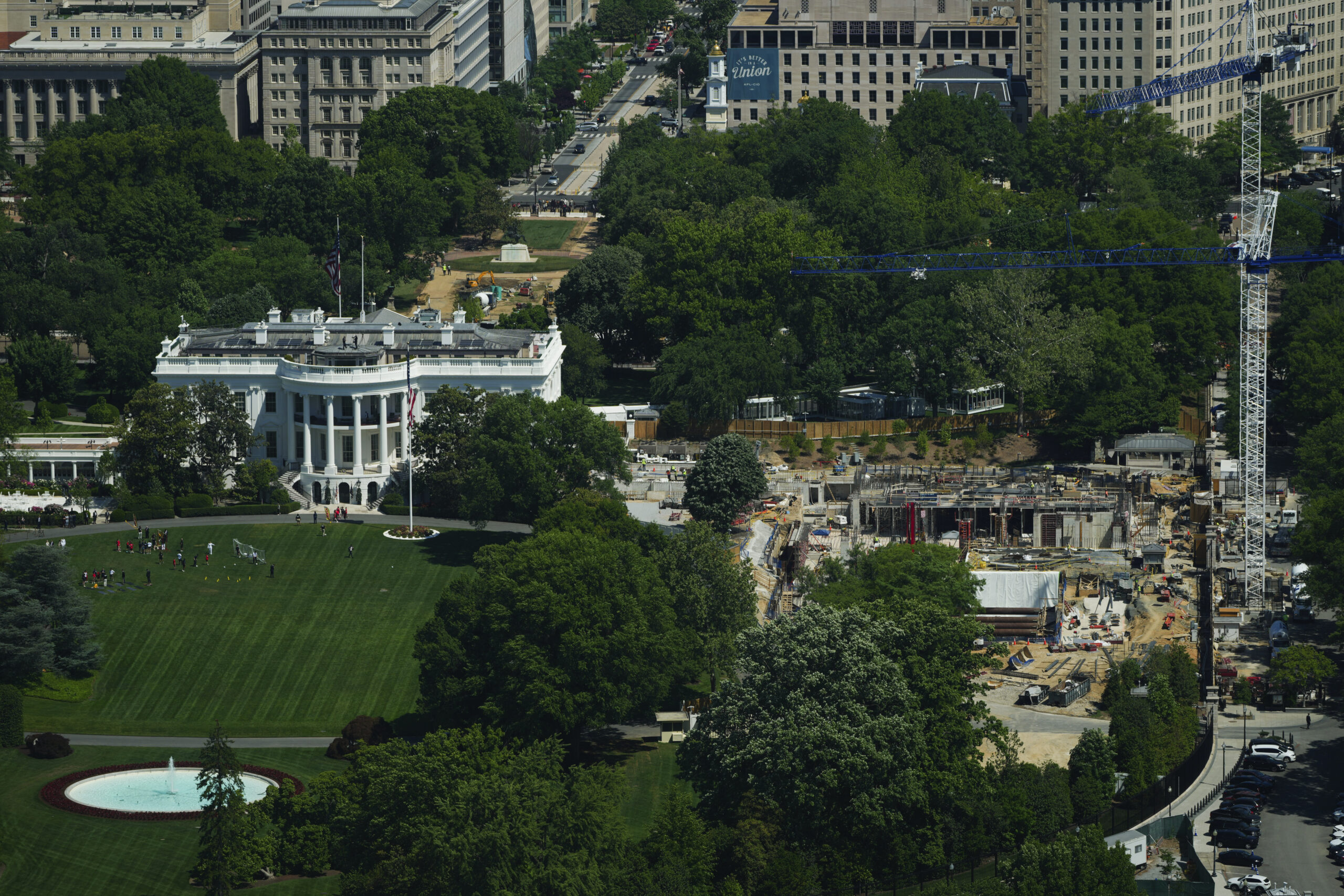
Construction on the new White House ballroom is seen from the Washington Monument, Tuesday, May 5, 2026, in Washington. (AP Photo/Julia Demaree Nikhinson)
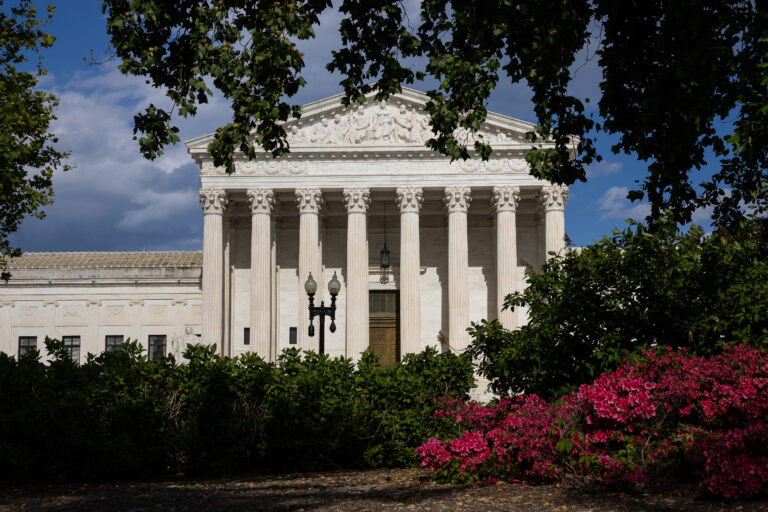
The Supreme Court will allow construction of the White House ballroom to continue — a victory for President Donald Trump on his plans to redefine the White House grounds and put his personal touch on the Washington skyline.
Read more Army Secretary to Step Down After Months of Tension With Hegseth
In the unsigned , the Supreme Court said the government is likely to prevail in showing that the National Trust for Historic Preservation, which had sued, does not have the legal right to challenge the East Wing project. It also said if the construction were stopped, national security would be harmed.
Chief Justice John Roberts wrote a dissent, joined by the three liberal justices, that said the construction “is likely unlawful.”
“The ballroom is a building or structure being erected on federal park grounds — President’s Park — in the District of Columbia. Yet Congress has not passed any law resembling ‘express authority’ for the Executive’s construction of it,” Roberts wrote.
Trending
-
Trump Is Quietly Working to Give Part of Yosemite to a Private Developer
-

Election Officials Brace for Chaos Over Trump’s Mail-in Ballot Rule
-
D.C. Police Officer Dies After Shooting at Station
-

Rep. Byron Donalds Received Mercy After Two Arrests. Now, He’s Making Sentences Tougher For D.C. Youth.
A federal appeals court in Washington, D.C., issued an injunction that would have halted work on Aug. 21, and the Trump administration asked the Supreme Court to step in. In the administration’s application to the court, it referred to the project as an “integrated military complex” vital for national security.
Trump celebrated the decision on Truth Social, saying the building will be “one of the Greatest ever constructed in Washington, D.C.”
“When completed in the Summer of 2028, the magnificent Ballroom and Military Complex will be something that the entire Country is very proud of,” Trump said in his post.
The National Trust said it was disappointed with the court’s decision but was pleased by the chief justice’s “strong dissent.”
The dissent “reiterated what we have maintained from the start of our case — that construction of the White House ballroom is unlawful,” Brent Leggs, the trust’s president and CEO, said in a statement. “In addition, this is not the final decision on the merits of our case and does not resolve our fundamental argument — that each president is a temporary steward of the People’s House and does not have the unilateral authority to demolish and redesign it without the approval of Congress.”
Read more Top General Says Military Has ‘No Plans’ to Deploy to Polls During Midterms
The administration argued that pausing construction would endanger the president’s safety, as well as that of his family, administration staff and foreign dignitaries who visit the White House.
The Supreme Court’s decision cited statements from heads of several federal departments and intelligence agencies, and pointed to arguments that the ballroom’s architecture was integral to shielding the planned underground military complex.
“Meanwhile, on the other side of the ledger and against these harms, the only harm the Trust claims is the offense one of its members will suffer from having to view a structure of the ‘scale,’ ‘height,’ and ‘massing’ the government intends,” the opinion states.
The court also disagreed that the National Trust had the legal right to pursue the case. The filing stated that the court has “repeatedly held that mere offense, disagreement, or distaste does not qualify as a concrete and particularized injury” under the legal argument the National Trust presented.
The opinion left room for further consideration of the case if it should reach the court again, saying that the court was not deciding the legality of the ballroom project.
The Trump administration tried and failed to obtain congressional backing for the project. After attempting to find bipartisan support, Trump allies in the Senate pivoted. They attempted to include $1 billion to the U.S. Secret Service “for security adjustments and upgrades” related to the ballroom’s construction in an expansive funding package that would only require Republican votes to pass. The effort later collapsed.
The original idea for a secure ballroom morphed into a multilayered project. The administration announced a military complex would be built below and a drone hub would be constructed above. The projected price rose in a commensurate manner.
The administration’s initial estimate was $300 million. Private donations would underwrite the project, it said. That has doubled. And half of the $600 million cost is expected to come from taxpayers, according to The Washington Post. In Trump’s post celebrating the decision Monday, he insisted that the entire project is privately funded.
Read more Republicans Are Urging SCOTUS to Give Them a Discount on TV Ads
About the Author