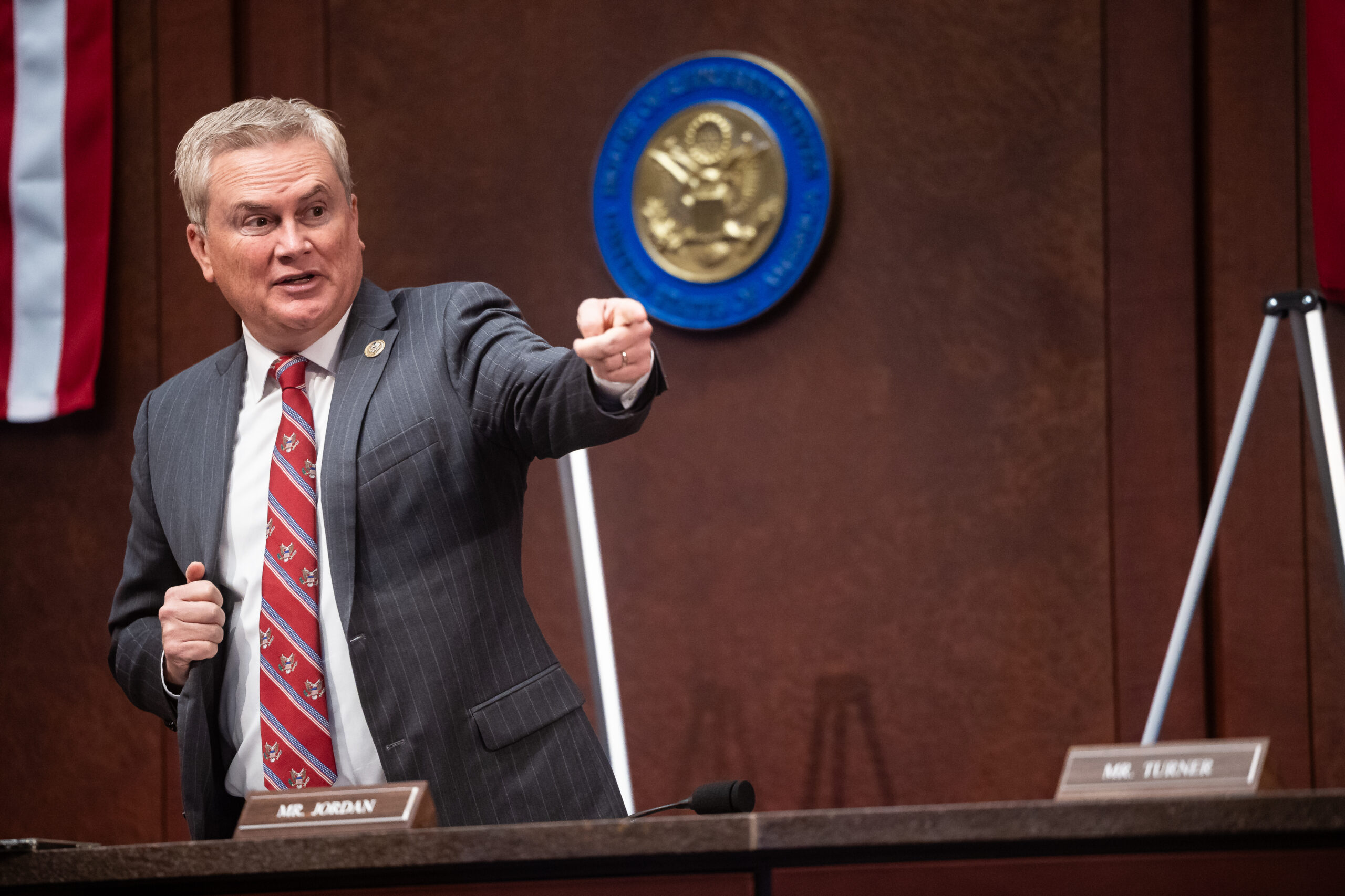
House Oversight Committee Chair James Comer (R-Ky.) presides over a markup on holding former President Bill Clinton and former Secretary of State Hillary Clinton in contempt of Congress for failing to comply with a subpoena on Capitol Hill Jan. 21, 2026. (Francis Chung/POLITICO via AP Images)
A House committee approved a bill Wednesday that would broadly restrict D.C.’s ability to increase or decrease local taxes and fees, again highlighting Republicans’ aggressive interest in managing how the city runs — down to the dollars and cents it collects.
Read more Second WHCA Dinner Isn’t a Security ‘Redo’ for the Secret Service, Officials Say
The bill passed the House Committee on Oversight and Government Reform on a party-line vote, sending it next to the full House for consideration. It faces much steeper odds if it gets to the Senate, though.
Speaking during a brief debate, committee Chair James Comer (R-Kentucky), who introduced the measure, said it would benefit residents and businesses and make the city more economically vibrant.
“Radical D.C. Democrats want to solve their spending problem by reaching deeper into taxpayers’ pockets and driving further on the path to socialism,” he said. “Actions like these only serve to hurt small businesses and the District’s already vulnerable residents. These are just more examples of bad policies that disincentivize investment, drive residents out and undermine the economic competitiveness of the city.”
Trending
-

Suspicion and Doubt at the National Civics Contest
-

Dana Milbank: Maybe Pete Hegseth Is the One With a Testosterone Problem
-

Trump’s Plan to Surge U.S. Arms Production Has a Huge Problem
-
USDA Workers Don’t Plan to Stay on the Job as Offices Relocate
But Comer also conceded that the bill is meant as a preemptive attack on a new class of elected officials who are expected to take office next year, including Ward 4 council member Janeese Lewis George, a democratic socialist who overwhelmingly won the city’s Democratic Party primary in June and is expected to cruise to victory in November’s general election.
“This bill enhances Congress’s constitutional oversight authority over D.C. to restrain irresponsible policies pursued by future socialist and ultra-progressive D.C. Democrats,” he said.
Lewis George has said D.C. should consider raising taxes on certain businesses and wealthy residents to collect new revenue as the city faces a sluggish economy, and the D.C. Council is expected to hold a hearing in the fall on possible revenue-raising options. Comer and other Republicans said Wednesday that city lawmakers should instead focus on cutting spending.
But congressional Democrats and city officials alike pushed back on Comer’s bill, calling it an unnecessary and unwelcome intrusion into plainly local affairs.
“D.C.’s locally elected leaders are accountable to D.C. residents, and local leaders should be empowered to address local matters without congressional interference,” said Rep. Robert Garcia (D-California). “If Donald Trump or congressional Republicans want to run D.C., they should run for mayor and D.C. Council.”
Congress has a significant amount of say in D.C.’s local affairs. Every bill passed by the council undergoes a 30-day review on Capitol Hill (or 60 days when a bill changes criminal law), during which time members of Congress have the power to stop any measure from becoming law. That has happened rarely since D.C. gained home rule more than 50 years ago, though more recently, Republicans have increasingly wielded the power — including a 2023 vote that rejected a sweeping rewrite of the city’s criminal code.
But city officials warned that Comer’s bill would effectively flip the existing process on its head, allowing council bills touching on taxes or fees to become law only if Congress proactively approved them.
Read more Software Vendor Denies Responsibility for New Jersey Voter-Registration Error
“The bill would straightjacket the District because it would paralyze our tax code,” Council Chair Phil Mendelson wrote in a letter to Comer, noting that D.C. Superior Court consistently faces a shortage of judges because confirmation votes are delayed in the Senate.
In her own statement, Mayor Muriel Bowser told Comer — with whom she has otherwise had a friendly relationship — that Congress could take other steps to help the city’s economy, which has been hit by President Donald Trump’s aggressive effort to trim the size of the federal workforce.
“While the federal government should not touch the District’s ability to raise and spend its local dollars, they can and should help us replace the economic activity lost through reductions to the federal workforce and a shrinking federal footprint,” she wrote.
Democrats on the House Oversight Committee, including Rep. Maxwell Frost (D-Florida), highlighted what they said was an inherent hypocrisy in the bill: Congress giving itself more responsibility over D.C. while facing persistent challenges passing an annual federal budget.
“We can’t even pass our own bills. Now you want to add to that and pass the bills of D.C.?” Frost asked. “You want to run the D.C. budget? Why don’t we run our own budget?”
While D.C. officials largely criticized Republicans for approving the bill, a second (and unexpected) target also emerged: DoorDash. Comer said during the debate that the food-delivery platform supported his bill, which DoorDash confirmed to NOTUS. John Horton, the platform’s head of North American policy, said its decision was motivated by the council’s recent approval of a 20-cent fee on all third-party deliveries in the city.
“We’ve said from the start that taxes like this fall hardest on the people D.C. says it wants to protect, and nothing has changed. We have always supported home rule for D.C., but will continue to do everything we can to defend D.C.’s small businesses, local economy, and underserved residents,” Horton wrote in a statement.
DoorDash’s decision prompted outrage from some local advocacy groups, including Free D.C., which called on residents to boycott the app. Ward 5 council member Zachary Parker similarly expressed his anger on social media.
“Every District resident should know that @DoorDash doesn’t support DC Home Rule and is actively working to undermine it by lobbying for the GOP’s efforts to control DC tax policies,” he wrote on X. “Govern yourselves accordingly, neighbors.”
Read more House Lawmakers Pass Bill Restricting Congressional Stock Trading
About the Author