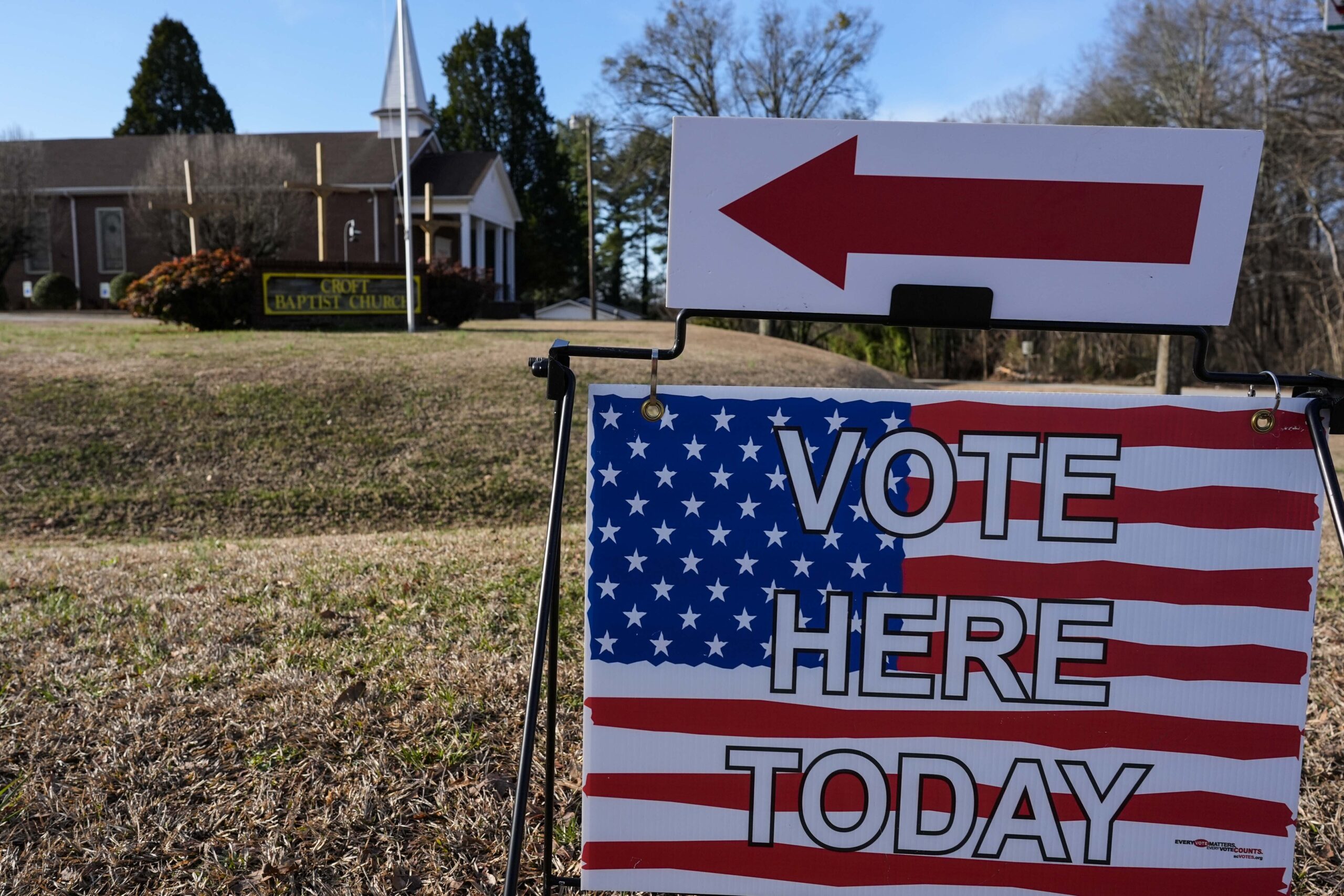
FILE - A voting sign is seen near a voting center at Croft Baptist Church, Feb. 24, 2024, in Spartanburg, S.C. A small but substantial chunk of GOP primary and caucus voters have said they'd be so dissatisfied if Donald Trump became the Republican Party's presidential nominee that they would ultimately not vote for him in November, according to AP VoteCast. (AP Photo/Mike Stewart, File)
A last-minute, aggressive lobbying campaign is underway over the phone and through the media, as Democrats from a handful of states jockey to lead off the presidential nominating calendar.
Read more House Committee Advances Bill Limiting D.C.’s Ability to Raise Taxes
South Carolina Democratic Party Chair Christale Spain appeared on Roland Martin’s YouTube show Monday to declare, “we’re first, and we maintain that.” At a private reception Wednesday night, Democratic National Committee members mingled with Nevada Sens. Jacky Rosen and Catherine Cortez Masto, while New Hampshire boosters reached DNC members with one-on-one phone calls.
The all-out push will culminate at the DNC’s Rules and Bylaws Committee meeting later this week. The 49-person panel is charged with setting the early-state window, ahead of what’s expected to be a wide-open and unwieldy Democratic presidential primary. Ahead of Friday’s meeting, tensions are already running high.
“It’s going to be a bloodbath,” said one of the members, who was granted anonymity to speak candidly. “Most states represented have at least one or two members on the committee, and I think they’re all going to fight to the death for this.”
Trending
-
Suspicion and Doubt at the National Civics Contest
-
USDA Workers Don’t Plan to Stay on the Job as Offices Relocate
-
Darline Graham? Republicans Don’t Know Her.
-
The Woman in the Photo Wanted to Be Alone. Instead, She Went Viral.
Interviews with nearly a dozen DNC Rules and Bylaws Committee members revealed some certainty about which states will likely be inside the early window — South Carolina, Nevada, New Hampshire and Michigan — but not necessarily the order. South Carolina and Nevada appear to be front-runners for the first spot over New Hampshire, according to these interviews. Members aren’t sure if they’ll add a fifth state to the slate, though if they do, New Mexico and Virginia lead that discussion.
“I believe South Carolina is in a good position, and our vote count is good. We made the case in May to be first, and we’ve been talking to members ever since then,” said Spain, the South Carolina party chair. “I believe we have the votes, but I think Nevada is the next-highest vote-getter.”
Setting the presidential primary calendar is one of the DNC’s most consequential tasks ahead of the 2028 presidential primary, and the Rules and Bylaws Committee must contend with its own internal politics over which states to elevate or demote — triggering debates over racial diversity and representation.
Members said they hoped to recommend a slate by Friday and send it to a full vote of the DNC at their meeting in Austin, Texas, next month. At least a few members are pushing to delay the decision until after the upcoming midterms, though others insist they must wrap it up as soon as possible.
“We need to rip the Band-aid off,” said a second rules committee member. “We’re going to make people mad no matter what, and it’s not going to get any easier after the midterms.”
Reordering the slate also made people mad in 2022, when then-President Joe Biden eliminated Iowa as an early state, elevated South Carolina to first and added Michigan. The party came under pressure to shake up its calendar after the 2020 presidential primaries, when technical difficulties upended the Iowa caucuses and candidates criticized Iowa and New Hampshire for their lack of racial diversity.
“There’s real ramifications, long-term ramifications, if we don’t make the right decision on the calendar,” said Jaime Harrison, the former DNC chairman who also served as the South Carolina Democratic Party chair. “Black voters are paying very close attention to this.”
South Carolina’s boosters are making their pitch publicly and privately, sharpened by the Supreme Court’s decision to further gut the Voting Rights Act this spring. They also argue that South Carolina’s relatively cheap media market, compactness and majority-Black primary electorate will be the best proving ground for future presidential candidates.
In a letter to DNC members and obtained by NOTUS, Rep. Jim Clyburn (D-South Carolina) warned in May that it would be a “profound mistake for our Party to retreat” from Black voters and Southern states in the nominating process, adding that South Carolina’s role in the nominating process “has been about ensuring that candidates engage deeply with the diverse coalition.”
Officials from Nevada are also campaigning aggressively to be first. They, too, leaned into their state’s racial diversity, particularly its Latino population. Over the last year, Nevada’s elected officials have made personal appeals to DNC members and frequently hosted events to promote the state. More than 20 Latino leaders and groups signed on to a letter Wednesday, urging members to elevate Nevada in order to “reverse” the trend of losing Latino voters to Republicans.
Read more Second WHCA Dinner Isn’t a Security ‘Redo’ for the Secret Service, Officials Say
“Choosing Nevada to go first is a strategic decision, as we work to win back the coalition we need to win back the White House in ‘28,” said Daniele Monroe-Moreno, the Nevada Democratic Party chair. “That coalition of rebuilding has to be a broad coalition, which has to include Black voters, Asian voters.”
Some members have suggested that the battle for first may include horse-trading on a fifth addition to the line-up. If Nevada were selected to go first, then members may add Virginia, putting two Southern states in the early window. And if South Carolina were to go first, then they could add New Mexico, another western state with strong Latino representation.
But DNC members have raised concerns about Nevada’s mail-in balloting, which could delay the results of the primary. Monroe-Moreno said the Nevada secretary of state’s office is “implementing adjustments and improvements” to its mail-in ballot counting.
“It may take a little more counting than another state,” she said. “I want to make sure that everyone’s votes are counted.”
Without a Democrat in the White House, the 49-person committee is charged with making its own decision on the calendar. DNC Chair Ken Martin has largely remained hands-off, but that could change over the next few days, the committee members said.
“I don’t think Ken needs any more headaches than he’s already got,” said one Democratic operative involved in the calendar process and granted anonymity to speak candidly.
The chaos of selecting a new calendar comes during a rocky year for the DNC. Martin has faced questions over his leadership after presiding over an incomplete autopsy of the 2024 election and staring down serious fundraising challenges. The Republican National Committee is sitting on $128 million in cash, while the DNC holds $16.3 million with $18.5 million in debts, according to the most recent Federal Elections Commission filings.
It’s not clear whether states or candidates will follow the DNC’s decision on the primary calendar, given the committee’s weakened position. At least three potential 2028 Democratic presidential candidates told NOTUS last month they were considering skipping the DNC’s debate schedule, while Iowa’s backers have already said they are seriously considering hosting a rogue caucus.
Last month, the DNC instituted stiffer penalties if a state jumps the line to head off these challenges. For example, if a candidate campaigns in a rogue contest, they’ll sacrifice debate stage access and the state will lose its delegates at the party’s 2028 convention.
New Hampshire already tested those boundaries in 2024, when it ran its own unsanctioned primary after Biden demoted the state from its first-in-the-nation status. The state is still expected to be in the early window, but several DNC members said “New Hampshire is a very distant third” behind Nevada and South Carolina for first. “They just don’t have the votes,” a third DNC member said.
New Hampshire Democratic Party Chair Raymond Buckley defended the state’s position, arguing in a statement that “anyone who suggests New Hampshire isn’t in a strong position is mistaken.”
“We’ve been focused on having conversations one-on-one with committee members, and we’re encouraged by how those have been going,” Buckley continued. “New Hampshire serves as a critical testing ground for whether candidates can attract independent voters — an issue that couldn’t be more pressing for the Democratic Party nationally.”
Read more Software Vendor Denies Responsibility for New Jersey Voter-Registration Error
About the Author